
4 Checks Before Setting Up a Trust for Borrowing

Over the past month, two major lenders, Macquarie Group and Commonwealth Bank, have made significant changes to trust and company lending. These shifts matter for anyone planning to buy property through a trust or considering setting one up.
In this guide, I’m sharing the four checks I walk through with pilots, medical professionals and business owners before they use a trust or company structure for borrowing.
(We first shared this update on LinkedIn, where many of our clients reached out with their thoughts.)
What has changed?
Macquarie Group paused new trust and company loans on 30 October. CBA now requires borrowers to have an existing CBA facility for six months before they assess trust or company lending applications.
These changes narrow the range of lenders willing to consider trust-based borrowing. For clients who genuinely need these structures, this reduces their available options.
These changes don’t make trusts or companies the wrong move. They simply mean the margin for error is smaller, and the structure has to genuinely serve a purpose rather than just being a way to stretch borrowing power.
When the structure is right, it supports protection, planning and long term strategy. When it is not, it adds complexity and risk.
That is where the conversation shifts from “Can we make this work?” to “Does this still make sense for your goals, your lender and your timeline?” For some clients, simplifying the structure ends up being the smarter path. For others, a trust remains the right fit; it just needs to be handled deliberately.
Here is how we bring that clarity back into focus with four checks we step through with every client.






How we respond
Check 1: Make sure the structure still works if life or income changes
A trust needs to fit your goals, income and risk level. Life changes, promotions, industry shifts and interest rate movements can all affect whether the structure still works for you.
If the trust stops fitting your situation, it can create problems later.
Check 2: Confirm the lender actually accepts the structure
Not every lender supports every type of trust or company setup, and policy is changing quickly. Macquarie and Commonwealth Bank have both tightened their approach, and other lenders may follow.
It’s important to confirm early that the lender you want to use will actually allow the structure.
Check 3: Ensure you have ongoing accounting, tax and cash-flow support
A trust is not a set-and-forget structure. It requires year-to-year management, including:
tax planning
accounting
cashflow strategy
distribution decisions
Without proper support, a trust can become more complex than it needs to be.
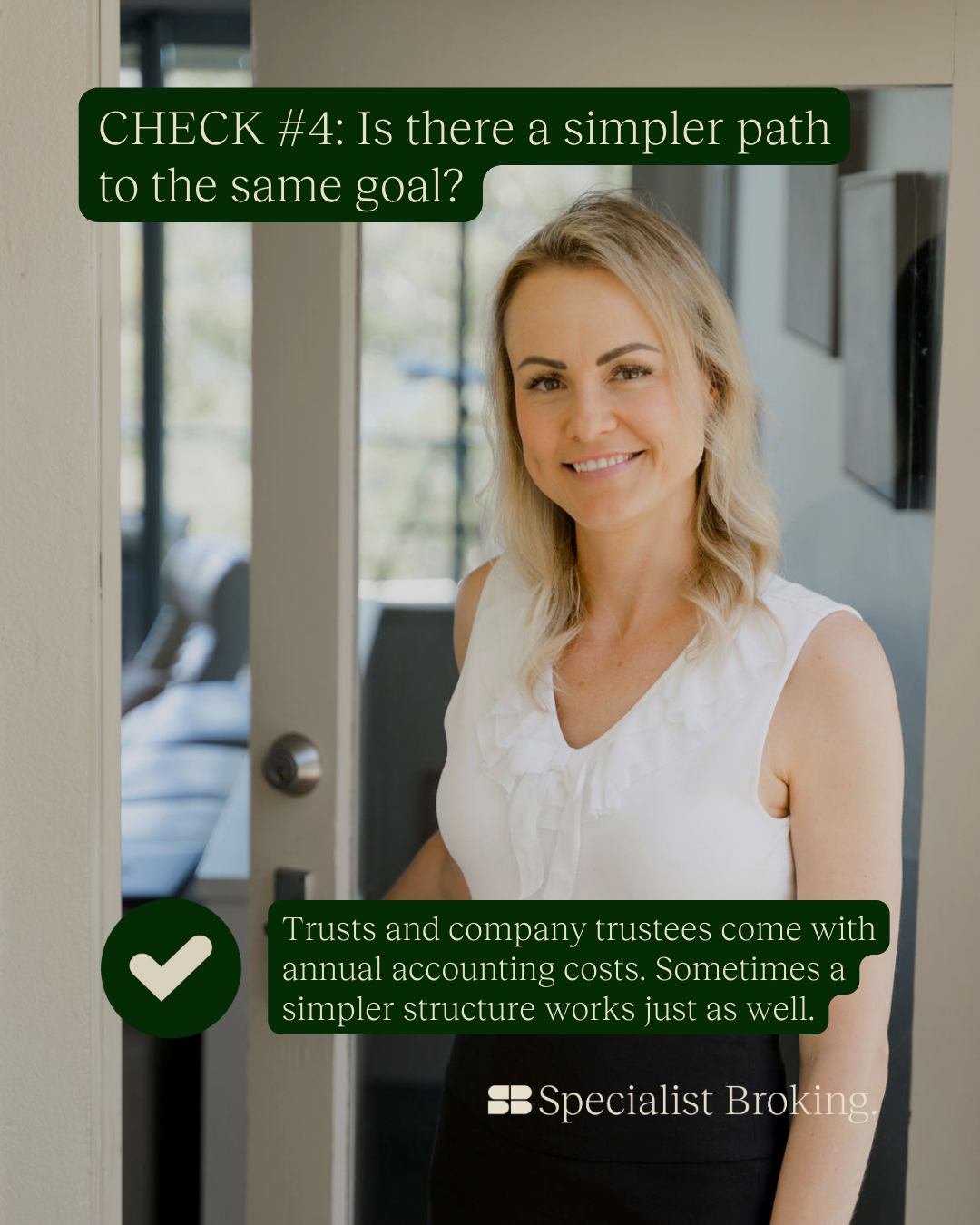
Check 4: Ask whether a simpler structure would achieve the same outcome
Trusts and company trustees come with annual accounting and administrative costs. Sometimes a simpler structure achieves the same result with less work and fewer ongoing obligations.
A good structure should make things clearer for you, not harder.
Why this matters
Lender options for trust or company borrowing are narrowing. These changes reduce choice for clients who genuinely need trust based lending.
Trust and company structures can be powerful tools, especially for clients with higher income, complex income, multiple properties or asset protection needs. They simply need to be matched carefully to someone’s goals, risk level and longer-term plans.
If you’re weighing up whether a trust still makes sense under the new rules, I am always happy to walk through the details.